
How We Generated 322 Qualified Admission Enquiries at ₹69.81 Per Lead – A Meta Ads Case Study for College Admissions
Most education businesses running Meta Ads face the same frustrating pattern: impressions climb, budget disappears, and the phone still doesn’t ring. For a B.Tech admissions client we work with, the story was different — and the numbers prove it.
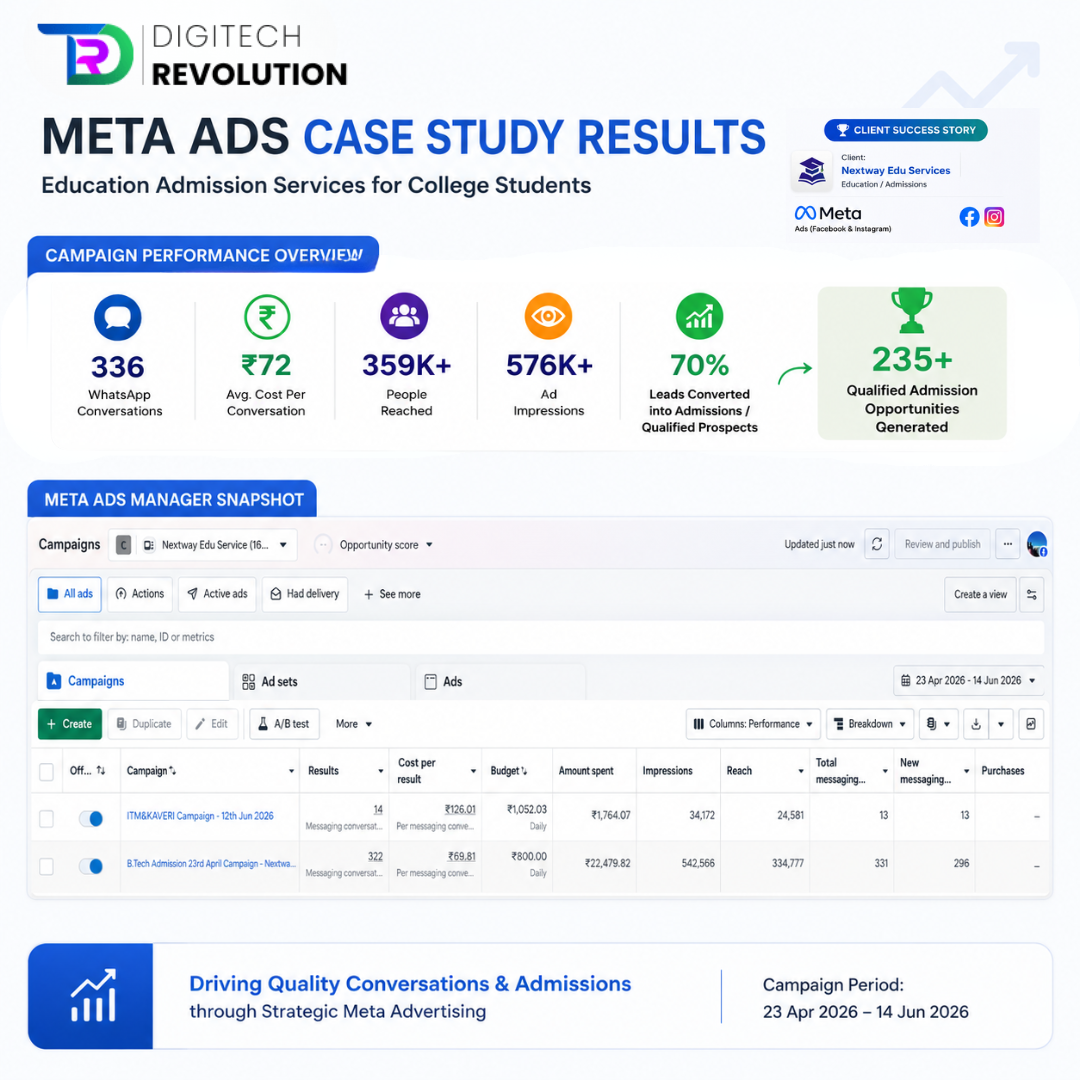
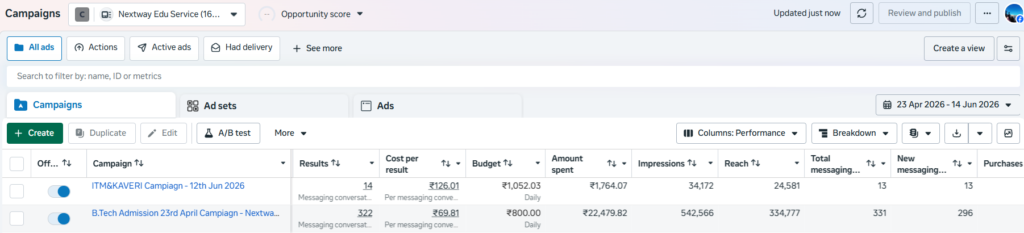
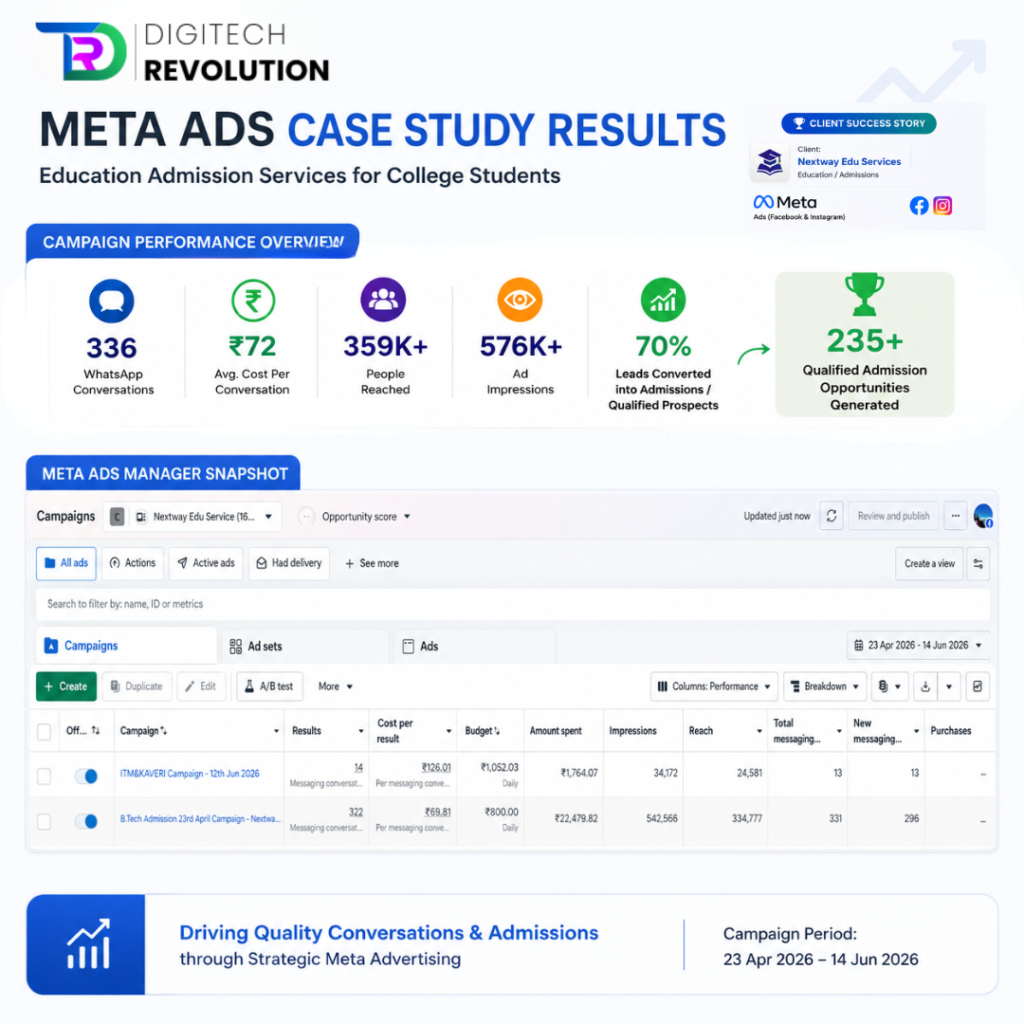
Over a recent campaign period, we generated 322 qualified admission enquiries at a cost of just ₹69.81 per result, spending ₹22,479.82 to reach 334,777 people and generate 542,566 impressions. Of those enquiries, 296 were entirely new conversations — meaning the campaign wasn’t just recycling the same warm leads, it was consistently pulling in fresh prospective students.
This is the breakdown of what we built, why it worked, and what any business running education marketing in India can learn from it.
The Starting Point: Why Education Admissions Campaigns Usually Underperform
Admissions marketing has a structural problem that most Meta Ads campaigns never solve. Parents and prospective students researching a B.Tech program don’t make a decision in one sitting. They compare colleges, check placement records, ask relatives, and revisit the conversation multiple times before reaching out. A campaign built around a single static ad and a generic “Enquire Now” button rarely survives that decision-making process.
The other common failure point is cost control. Education advertisers in India often see costs climb fast because the audience is broad — every parent with a child in Class 12 is technically “in market” — and broad audiences without proper structure burn budget on people who were never going to convert.
For this client, the brief was clear: generate a consistent flow of genuine admission enquiries, keep cost per lead sustainable, and make sure the leads were real conversations — not empty clicks.
The Strategy: Messaging Conversations Over Form Fills
The single most important decision in this campaign was the objective. Rather than running a traditional lead form campaign, we structured both campaigns around messaging conversations — directing prospective students straight into a chat conversation rather than a static form.
This matters specifically for the Indian education market. Indian buyers — and especially parents making decisions on behalf of their children — want to ask questions before committing to anything. A lead form captures a name and a phone number. A messaging conversation captures intent, context, and a live opportunity to answer “what’s the placement record like” or “what’s the fee structure” in real time, before the prospect loses interest.
The results validate this approach. The B.Tech Admission campaign generated 331 total messaging conversations and 296 new messaging conversations against 322 total results — meaning almost every result represented a genuinely new conversation with a prospective student, not a repeat interaction or admin overhead.
Campaign Structure: Two Campaigns, Two Different Jobs
We ran two distinct campaigns simultaneously, each doing a different job in the admissions funnel.
Campaign 1 — B.Tech Admission Campaign. This was the primary volume driver. With a daily budget of ₹800, the campaign spent ₹22,479.82 over the period and generated 542,566 impressions and a reach of 334,777 people. The cost per result came in at ₹69.81 — a figure that holds up well against typical education-sector Meta Ads benchmarks in India, where cost per lead frequently runs two to three times higher when campaigns aren’t properly structured around conversation-based objectives.
Campaign 2 — ITM&KAVERI Campaign. Running alongside the primary campaign with a smaller daily budget of ₹1,052.03, this campaign targeted a more specific audience segment, generating 14 results at ₹126.01 per result from 34,172 impressions and a reach of 24,581. The higher cost per result here reflects a narrower, more qualified targeting approach — appropriate for a segment where lead quality mattered more than lead volume.
Running two campaigns with different cost structures side by side is a deliberate strategy, not an oversight. It lets us compare performance across audience segments in real time and reallocate budget toward whichever segment is converting more efficiently — a decision that’s impossible to make with a single undifferentiated campaign. The same logic applies whether the spend is running on Facebook placements or Instagram Ads — both platforms sit inside the same Meta Ads Manager account and respond to the same conversation-based optimisation strategy.
Why the Cost Per Result Stayed Low
A ₹69.81 cost per messaging conversation for a B.Tech admissions campaign is a strong result, and it didn’t happen by accident. Three specific decisions kept it there.
Conversation-based campaign objective. As covered above, optimising for messaging conversations rather than link clicks or generic engagement meant Meta’s algorithm was being told exactly what a good outcome looked like — and it optimised delivery toward people likely to start that exact conversation.
Continuous creative monitoring. Education audiences fatigue on ad creative faster than many other sectors, because the same parents and students see admission ads repeatedly during the application season from multiple colleges. Campaigns left untouched for weeks see costs climb as the same creative gets shown to the same exhausted audience. Active management — watching frequency and refreshing creative before fatigue sets in — is what keeps cost per result stable over a sustained campaign period rather than spiking after the first few weeks.
Budget discipline matched to objective. The ₹800 daily budget on the primary campaign wasn’t an arbitrary number — it was sized to give Meta’s delivery system enough daily signal to keep learning and optimising without overspending before the algorithm had enough data to work efficiently.
What 296 New Messaging Conversations Actually Means for an Admissions Team
Numbers on a dashboard only matter if they translate into something an admissions team can act on. Here’s the practical translation: 296 new conversations over the campaign period means an admissions team had nearly 300 fresh, warm conversations with prospective students who had already shown active intent by initiating a chat.
That is fundamentally different from a list of 296 phone numbers from a lead form, where a significant percentage won’t pick up, won’t remember filling the form, or were never seriously considering enrolling. A messaging conversation starts with the prospect already engaged and asking a question — which means the admissions team’s job shifts from “convince someone to talk to us” to “answer the question they already have.” That shift alone tends to improve conversion rates further down the admissions funnel, even though it isn’t a metric Meta Ads Manager shows directly.
The Honest Limitations Worth Naming
No case study is useful without being honest about what the numbers don’t show. Cost per messaging conversation tells us the campaign is efficient at starting conversations — it doesn’t by itself tell us how many of those 322 results converted into actual enrolled students. That conversion data lives further down the funnel, inside the client’s admissions CRM, and is the next layer of optimisation worth tracking for any education business serious about understanding true return on ad spend rather than just lead volume.
It’s also worth being clear that ₹69.81 per result is specific to this client’s market positioning, program type, and competitive landscape during this particular admissions cycle. Cost per result for Meta Ads in education varies significantly based on the specific course, the college’s existing brand recognition, and how competitive the admission season is in that region. The principles behind why this campaign performed well — conversation-based objectives, active creative management, and properly sized budgets — apply broadly. The exact number does not.
What This Means If You’re Running Education Marketing in India
If you’re managing admissions marketing for a college, coaching institute, or training program, three takeaways from this campaign are worth applying directly.
First, reconsider whether your campaign objective matches how your audience actually makes decisions. If your prospective students and their parents need to ask questions before committing —which is true for almost all of Indian education — a messaging-conversation objective will likely outperform a static lead form, because it matches the natural decision-making behaviour rather than fighting against it.
Second, don’t leave a campaign running unattended for weeks at a time. The gap between a campaign that maintains ₹69.81 cost per result and one that creeps up to ₹200+ over the same period is almost always active management refreshing creative, watching frequency, and adjusting budget allocation based on what the data is showing week to week.
Third, track what happens after the messaging conversation starts. The campaign’s job is to generate qualified conversations efficiently. Whether those conversations turn into enrolled students is a function of how well the admissions team handles the follow-up — and that’s worth measuring just as closely as the ad metrics themselves.
Paid Meta Ads also perform better when they’re not working in isolation. An admissions page backed by consistent organic Facebook marketing and active Instagram marketing builds the kind of social proof and brand familiarity that makes a prospective student more likely to message back when they see a paid ad — rather than scrolling past a name they’ve never encountered before. For institutions managing multiple platforms at once, a coordinated social media management approach across organic and paid keeps the messaging consistent everywhere a prospective student might encounter the brand.
How We Approach Meta Ads for Education Clients
This campaign was led directly by Priyanka V. Khanna, who personally manages the strategy, campaign structure, and ongoing optimisation for every Meta Ads account at DigiTech Revolution including this one. That means no hand-off to a junior account manager after onboarding, and no campaign left untouched between monthly reports.
For education businesses specifically, our approach starts with understanding the actual admissions funnel not just running ads in isolation. Campaign objectives, creative strategy, and budget structure are all built around how your specific audience researches and decides, the same way they were for this B.Tech admissions client.
If your education marketing is generating clicks but not genuine enquiries, or if your cost per lead has been climbing without explanation, a free Meta Ads audit is the fastest way to find out exactly what’s happening in your account and what a properly structured campaign could look like for your specific program and market.
You can also explore our broader PPC and paid search services if you’re considering Google Ads alongside Meta Ads as part of a complete admissions marketing strategy.
Frequently Asked Questions
What is a good cost per lead for Meta Ads in the education sector in India?
Cost per lead for education Meta Ads in India typically ranges from ₹100 to ₹400 depending on the course type, competition level, and campaign structure. A figure like ₹69.81 per result, as achieved in this campaign, sits well below typical benchmarks and reflects a conversation-based objective combined with active account management. Costs vary significantly between metro and tier-2 city targeting, undergraduate versus postgraduate programs, and how saturated the admission season is in a given region.
Why do messaging conversation campaigns work better than lead form ads for college admissions?
Messaging conversation campaigns work better for education marketing because the Indian admissions decision process is inherently consultative — parents and students want to ask specific questions about fees, placements, and eligibility before committing to a form fill. A lead form captures contact details with no context. A messaging conversation captures genuine intent and gives the admissions team a live opportunity to address objections immediately, which tends to improve downstream conversion to enrolment.
How much should a college or institute budget for Meta Ads during admission season?
Budget should be sized to give Meta’s delivery algorithm enough daily signal to exit the learning phase efficiently — generally a minimum of ₹500–₹1,000 per day per active campaign is needed for stable, optimised delivery. Spending too little spreads the budget too thin for the algorithm to learn effectively; spending too much too fast without proper campaign structure leads to overspending on unqualified reach. The right number depends on the specific program, target geography, and admission timeline.
How long does it take to see results from a Meta Ads education campaign?
Most Meta Ads campaigns need 7–14 days to exit the initial learning phase before cost per result stabilises. Meaningful, consistent lead flow is typically visible by week 3–4, once the algorithm has enough conversion data and creative fatigue is being actively managed. Admission campaigns tied to a specific intake date should ideally start 6–8 weeks before the application deadline to allow for this learning period plus sustained delivery.
Can this same strategy work for other types of education businesses, not just B.Tech admissions?
Yes — the core principles behind this campaign’s performance apply broadly across education marketing: coaching institutes, skill development programs, school admissions, and online course providers. The specific objective (messaging conversations), active creative management, and properly sized budgets are platform and strategy decisions that transfer across course types. What changes is the targeting, creative angle, and messaging — which should always be built around how that specific audience actually makes its decision.